

Tannic Panic! Issue #139: Barnacles & Sea Slime
Taking a coke bottle monocle to the “science” of “deep sea aging”


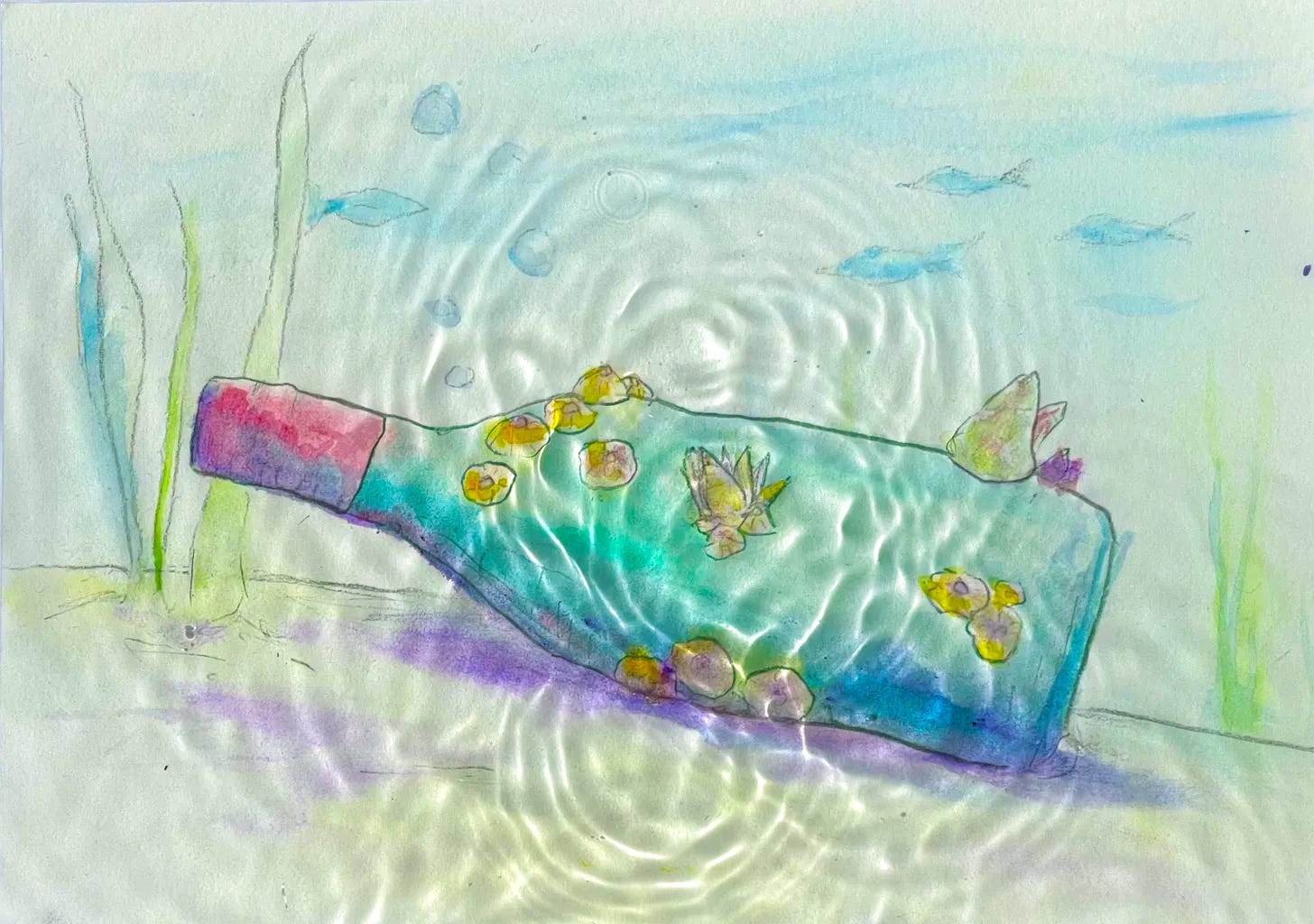
There’s a “trend” in the proverbial world of wine that is growing in popularity with every waking second – one that at first glance seems like little more than real-life clickbait over novelty: deep sea wine aging.
A lot of romanticism has built up around this idea (a “movement” that has gained traction in recent years due to several shipwrecks containing hauls of intact Champagne from the late 19th and early 20th century) – and some people seem to be convinced that somehow the mere existence of “the sea” vis-a-vis “a wine bottle” has a positive impact on the wine itself.
But is it just a bunch of meaningless new age hoo-haw, or is there something to this idea?
In order to “answer that question” we need to “fashion ourselves” with a humble understanding of the mechanisms that occur when wine “matures” (UNLIKE ME).
Our primary focus for this post is this study which explores the various changes that occur in wine when aged above and below the “deep blue sea.”
The “Chemical Budget” of Aging
Much like us, wine also carries a flimsy little wallet around with it – but wine’s flimsy little wallet isn’t filled with dust and empty space where flimsy little dollars once were. No; wine’s flimsy little wallet is filled with “chemicals” (the natural kind) that are constantly undergoing “little changes” as the wine embarks on its wonderful little journey through its wonderful little life. And, LIKE US, it must “budget” accordingly.
Whether a wine sits in a neolithic cave or on the sandy ocean floor, its chemical composition is on a timer. The “study” highlights a universal decline in four key areas regardless of the environment (i.e. whether or not in contact with oxygen):
Phenols: These give wine its so-called structure and “health benefits”
Anthocyanins (a type of polyphenol): The pigments responsible for that vibrant red and/or purple color we all “know and love”
Non-flavonoid compounds: Other “structural” elements (LIKE ME!)
Sulfur Dioxide (SO2): The primary preservative used in most wines
The Old Man and The Sea vs. The Cellar
There is no “magic” transformation: findings show that underwater aging doesn’t really do much to the wine itself (when compared to other environments with similarly stable conditions).
Stability: While the chemical profiles remained remarkably similar to cellar-aged wines, the underwater environment does offer a strong combination of constant pressure and near-perfect temperature stability (when at the proper depth). It also offers an environment in which no “outside” oxygen can transfer between the cork and the inside of the bottle, meaning that oxidation can only occur using the oxygen contained between the cork and the wine in the bottle beginning from the moment it starts its wonderful little “plunge.” (Wonder if they’ve heard of screw caps?)
The Color Evolution (anthocyanins & their little friends)
One of the most visual parts of a wine’s “geriatric transformation” is the reduction of anthocyanins. In young red wine, these molecules are mostly “free” (UNLIKE ME!), giving it a bright, sometimes even purple or bluish hue (for example, wines like Malbec and Petit Sirah are sometimes described as being more blue (LIKE ME) in their youth). As the wine ages (above or below water), these molecules “make friends” with tannins to form more stable polymeric pigments.
The Result: The wine shifts from a wonderful little purple/ruby color to a more brickish/tawny “hue”.
Cellar vs Sea: This process happens at a similar rate in both storage methods, suggesting that “time” is a more powerful “architect” of a wine’s “complexion” than “location.”
Oxidative Stability & SO2
The study found a gradual reduction in total sulfur dioxide (SO2)
As SO2 drops, the wine becomes more susceptible to oxidation & biological contaminants.
The So(2)-called “Science”: Aging wine is essentially a “slow-motion controlled oxidation” with some other “little reactions” for “funsies.” If it happens too fast and in the presence acetobacter, you get vinegar; if it happens too slow (or with zero oxygen), the wine can become “reduced” and smell like matchsticks or cabbage. There’s a reason that effective wine aging cannot really be rushed, in spite of products that claim to achieve that effect – it’s the combination of short term and long term reactions that produce the profiles we associate with a “perfectly” aged bottle. An oxygen deprived environment becomes more relevant in the context of SO2-related changes, because with less oxygen exposure, there is less reactivity with the SO2, meaning the wine remains stabilized by it for longer. That doesn’t necessarily mean it is better or worse, the oxidative processes just progress more slowly.
So What Does Underwater Aging Actually Achieve?
NOTHING!!!!! Just kidding. It provides highly stable (LIKE TODAY’S YOUTH!) conditions (which are also achievable above water), and it ensures an almost entirely oxygen-free environment (no transfer from external atmosphere), which means that oxidative aging is curtailed. This allows deep sea bottles to age more slowly and preserve more of the primary fruit aromas for longer. The SO2 levels decline more slowly, but other reactions aren’t slowed as much, like phenolic binding with tannins, which means that the aging process is less uniform (when held side by side with a terrestrially-aged bottle). Structurally a wine will proceed along a more consistent trajectory, while other profile features like “fresh fruits and vegetables” (THE GOOD KIND!) stick around for longer.
Whether you prefer the resultant wine is obviously subjective, but the main question to ask before stuffing your precious little wine sack into the briny deep is this:
Do I want to preserve the current state of the wine for as long as possible, while collecting a few “slimy barnacles” in the process?
> If you answered ‘yes’ then deep sea aging may be the drug for you!
> If you answered ‘no’ and you want your wine to age the way wine typically does as the years pass us by, then go ahead and find a nice dark, dusty, and moldy little basement somewhere and stuff your treasured wine sack there.
And of course, if our “calculations” are correct, capping your wine with a screw top and storing it in a cellar would yield very similar results, though you would be depriving it of a nice salty oceanic environment where the bottles can enjoy scenic views of sea-garbage and murk.
Until next time, HAPPY DRINKING PEOPLE.
Cheers,
Isaac & Zach
In short, it's worth a try, albeit at some extra expense, but then so too does my cool storage.
I like the painting!