

Tannic Panic! Issue #138: DIY Rosé
In this latest installment of our "Wine Alchemy" series, we're doing a little post-bottle blending to make our own "rosé"


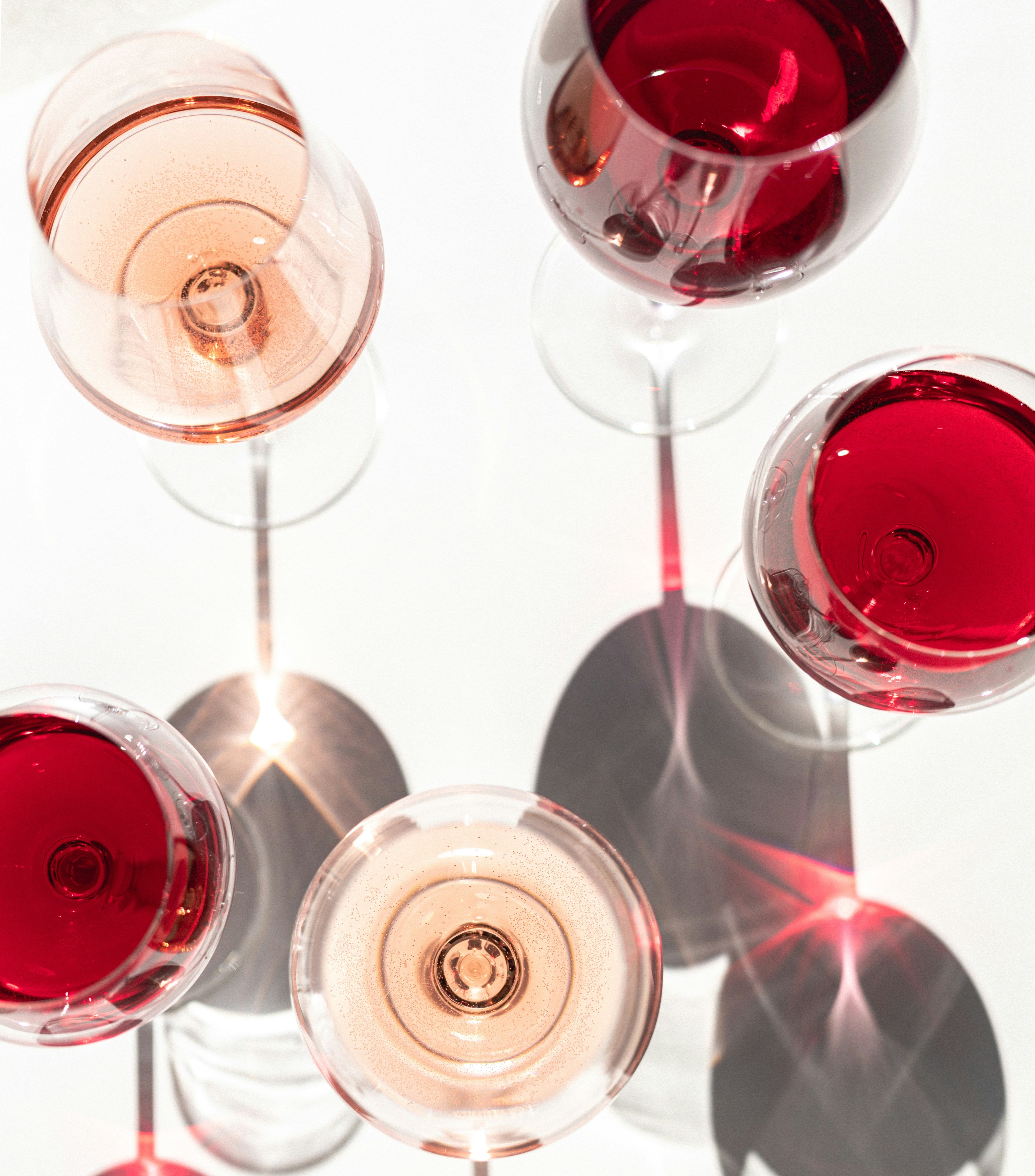
Here’s a “Valentine’s Day” date idea “you” never knew you “needed” – blend your own special pink juice (FOR SHARING!). You can use your personal preferences, or roll the dice on bottles that feel like they “represent” your “relationship” by finding one that represents each of your withered little “hearts,” and mixing em together (~waggles eyebrows~).
If you are your own Valentine this year, feel free to make a blend that represents your relationship with yourself.
Unlike our previous blending recipes, we’ve gone with one that uses a white wine as a base and shuffles in a little goodly “red” for “color,” structure and “added intrigue” – a method of blending that is actually used in some scenarios to create rosé pre-bottling, though outside of Champagne and other sparkling rosé production areas, it is the least popular (LIKE ME!).
If you are interested in learning more about the “other” rosé making techniques, we’ve gone into a little more depth on those in previous posts:


But today isn’t an ode to rosé. It’s “Wednesday” (a broken calendar is right twice a month) and this post is about wine alchemy — one of our favorite little topics to scromit at you about whenever we get the chance. It’s such a great way to take relatively inexpensive bottles (you can go premium too, if you please) and concoct something that really “amplifies” the so-called “bang per buck” quotient we’ve all heard so much about.
We’ve diven (dived? dove?) more deepishly into our philosophies and suggestions for approaching this process in previous posts as well, so we won’t bog you down with retreading the same material, but if you missed those, we “encourage you” to “familiarize” your “brain:”


Some quick “tips” for your blend:
THE RED WINE should have a clearly identifiable feature that you are looking to add, and it should be specifically something you don’t expect to find in the white wine. For example, if the white wine is floral and stone fruity but not especially high acid, you might pick a highly acidic red with black fruit notes to see what that adds to the equation. Or maybe you want to add a touch of oak to an unoaked base. And of course, color is a given here, so worst case you blend a rosé “in name alone” that simply tastes like the base white – but ideally there’s something unique that changes the overall structure or profile enough to create something new and exciting or at very least, more interesting.
THE WHITE WINE should be a decent base wine that you wouldn’t mind drinking on its own. This is important as it comprises most of the blend, but it’s fine if it has some shortcoming, especially if you have a red in mind that “fills in” the proverbial blank
YOU MUST select a red wine blending “partner” that is either “good” on its own or has an element that will complement the white wine “backbone”
YOU MUST blend your wine with a human (and/or sentient “farm animal”) “partner” that is willing AND ABLE to scromit WITH you, ideally in a public location. [NOTE: self-partnership is acceptable]
WE RECOMMEND using a red wine you enjoy on its own as well if you can, because the naturally reduced percentage you include to achieve the desired color (AN EXERCISE IN ‘RESTRAINT’) means that you’ll have some “leftovers” to “enjoy”
So without further ado, here’s our blend of the issue:
… AND NOW FOR THE REVIEWS (IN ORDER OF PRICE):
[CLICK HERE FOR A BREAKDOWN OF HOW OUR 100PT RATING SYSTEM WORKS]
THE BLEND: 2024 Martin Codax Albarino (85% of blend) + 2021 Chono Syrah, Limari Valley, Chile (15% of blend) / $14 for each wine
Profile: Peach, strawberry, cantaloupe melon, lemon juice, orange creamsicle, rose petal, crushed rock, sea spray, white pepper
Palate: Dry, medium body, low tannin, high acid, long finishThe Albariño “opened its arms” and “offered” a solid base of ripe stone fruits, citrus and high acidity along with typical “oceanic” “mineral” notes. It was lean and light, and was a great place to start, because “we” knew we had some foundational structure, along with aromatic and flavor components that we already enjoyed.
What we then sought out in a “blending partner” was something with a bit of “heft” that would add new fruit flavors, body, and some spice which could all contribute meaningfully to the blend. The question then was how intense did each of these features need to be to be perceptible and useful as a harmonious addition to the “pink beverage experience™.”
The Syrah was on the more “medium bodied side” of the spectrum (could perhaps have gone with something fuller than that, but this split the difference between the attributes we were looking for at the “under $15/bottle” price point nicely). It was primarily red fruit driven with some peppery spice, probably “thanks” to its “coastal roots” and “cooling influences” (LIKE MINE).
It could just be the voices in my head, but this blend really “spoke to me” (THE GOOD KIND!). The color was beautiful which is half the battle these days. The Syrah succeeded in “sharing” it’s “body” with the Albariño, along with a little of that spice and fresh red fruit — and the Albariño “reciprocated.” The rest is up to your imagination.
Score Breakdown: Balance 36 / Aroma + Flavor 17 / Concentration 12 / Complexity 7 / Length 15 = 87 Points (Z)
We love doing these little post-bottle blending experiments because they give an opportunity to not only do something entertaining with one of our favorite “liquids,” but to also think about wine in a new way that makes analyzing its qualities more fun and often yields exciting and unexpected results. Sometimes, you’ll even find that you make something better than the sum of its parts. Other times you’ll find that you make something worse — but that’s all “part of the fun.”
We love you.
Until next time, HAPPY DRINKING PEOPLE.
Cheers,
Isaac & Zach