

Tannic Panic! Issue #145: The Death of Napa
How a name once synonymous with quality lost its meaning


OH, how the “mighty” have fallen.
Literally the entire world has been asking us why we don’t write about Napa wines more often.
The answer won’t surprise you: “LOL”
But put another way, the prices are a joke. They are a severely bad source of value for several severely “important reasons” and at this point the bulk of your money isn’t going towards the wine in the bottle, it’s going towards the severe debts incurred by the producers paying for real estate, vanity projects, and “luxury branding” wherein triple digit price tags are considered a “marketing strategy.”
Suchly, it’s no surprise that the region is panicking (LIKE US!) – the quality that built the prestige no longer justifies the costs for the 99% (even when the product is good), and only those with severely overpacked wallets can afford to patronize their severely underpacked tasting rooms and waltz back home with their little Screaming Eagles and magnum Opus Ones.
So how did “we” get here?
Firstly, the “land” for viticulture in the Napa Valley is literally the most expensive in North America.
Secondly, so-called Napa viticulture is generally labor-intensive and “low yield,” with only “2 or 3” (GIVE OR TAKE) hard working “vineyard workers” plucking the sparse grapes on each “hectare” of “land.”
DID YOU KNOW… Napa Valley accounts for just 4% of California’s harvest despite having 8% of its vineyards, because clusters are thinned to prioritize quality over jug juice (LINK)
These first two “bullet points” mean that in order to have a widely available product with “Napa” on the label, two corresponding pressures are built in – the price of what is inside the bottle rises to account for the “value” of the land, and sacrifices must be made to quality if producers want to increase the volume of production without buying additional land.
As a result, “value” Napa wine, in the traditional sense (ie, extremely high quality fruit in wines that are actually worthy of prestigious awards) doesn’t really exist. If you see a relatively “affordable” (by Napa standards, OR OTHERWISE) bottle, then you probably aren’t actually getting the quality you may have imagined the word Napa on the label represents.
Thirdly, and most pretentiously, the Napa Valley is viewed by “rich, famous and stupid (UNLIKE YOU!) people” as a luxury brand in the wine World, historically allowing the producers to get away with exorbitantly large “price tags.” The proverbial “other shoe” is beginning to drop, and as time goes on, this business model, along with the soaring overhead costs associated with the land, have led to a situation where about half of the wineries in Napa are constantly losing money.
What’s the solution?
The response by some of the “big boys” in the industry has been to essentially take the top wines and make them MORE expensive so as not to diminish their super premium image in the eyes of their wealthiest buyers in a market where the general population is no longer a source of sufficient demand to maintain profits (this, of course, only widens the affordability divide). Meanwhile, the producers lowering price tags to try to drive demand actually tend to see declining sales and have a “difficult choice” to make: go out of business (WE’VE ALL BEEN THERE!), or find a way to make bottles more “profitable.”
Regardless of approach, one fact holds true: in order to make a bottle of wine more profitable, the cost of what’s in the bottle must go down relative to the price the consumer pays — so if you aren’t increasing your bottle prices, costs must be cut and spending likely shifts towards demand generation (marketing) and away from premium winemaking.
The end result, without any ifs, ands, or these so-called “buts” we’ve all heard so much about, the quality to price ratio goes down.
AND THUS, “A NEW ERA BEGINS”
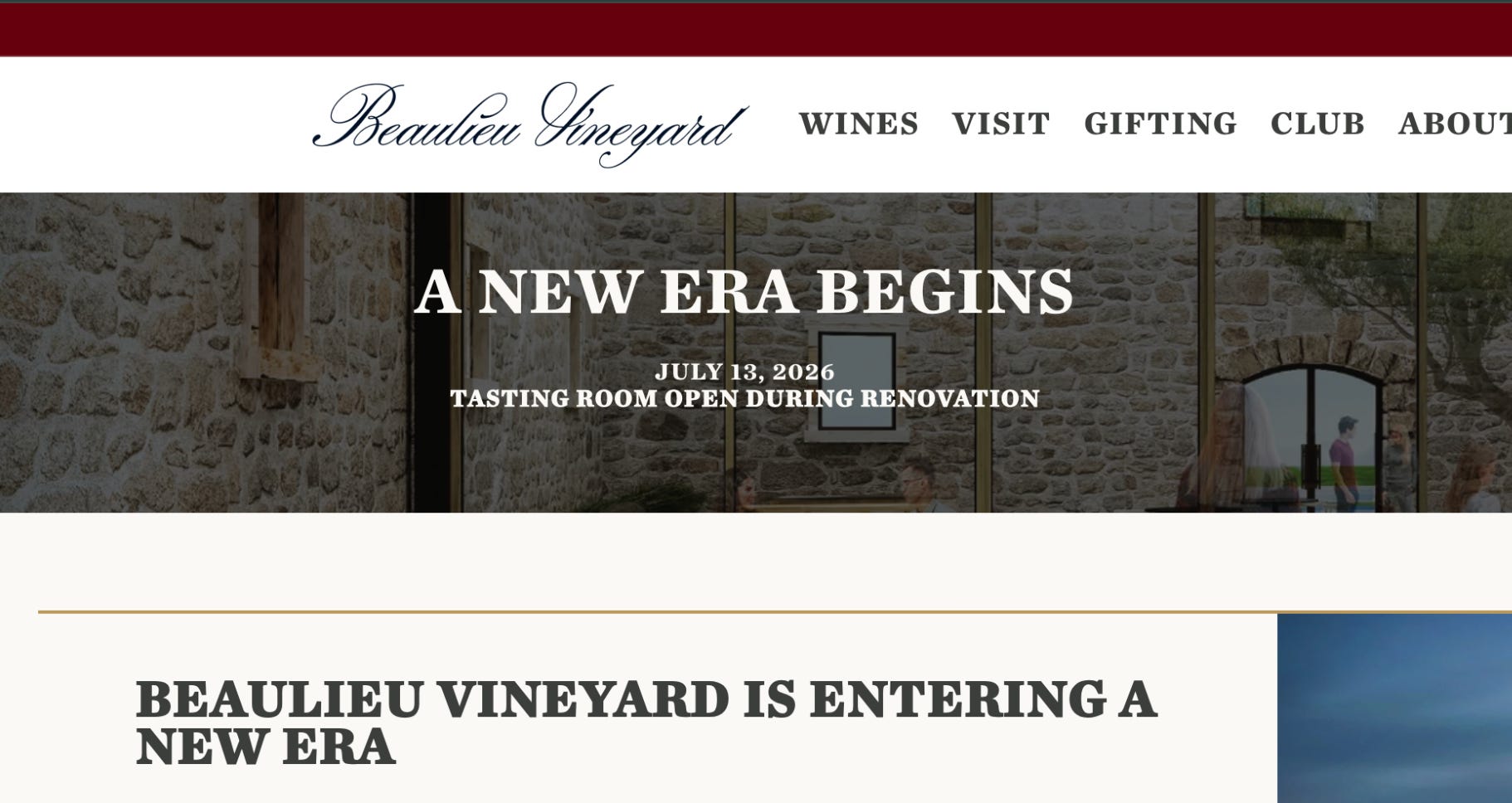
Now, before anyone gets the sense we are up in arms trying to disparage producers just out there trying to make “ends meet,” we should note that we specifically chose BV because “we” had a handful of well-aged wines from the producer that we wanted to taste, and we thought it would be interesting to see how they stand up to a more modern day example that is readily available across the country.
What we found did not surprise us and represents a trend that is in no way unique to this producer. As we hopefully illustrated above, it is a combination of factors leading to this sort of behavior from all manner of large producers in the region so no one wine house is to blame. That said, it is this very approach to present day Napa winemaking that has led to a crisis of identity – products that many passionate wine drinkers and aficionados tend to avoid, in spite of what they once represented.
Without further ado, let’s enter this so-called “new era” and “see what happens.”
… AND NOW FOR THE REVIEWS (IN ORDER OF PRICE):
[CLICK HERE FOR A BREAKDOWN OF HOW OUR 100PT RATING SYSTEM WORKS]
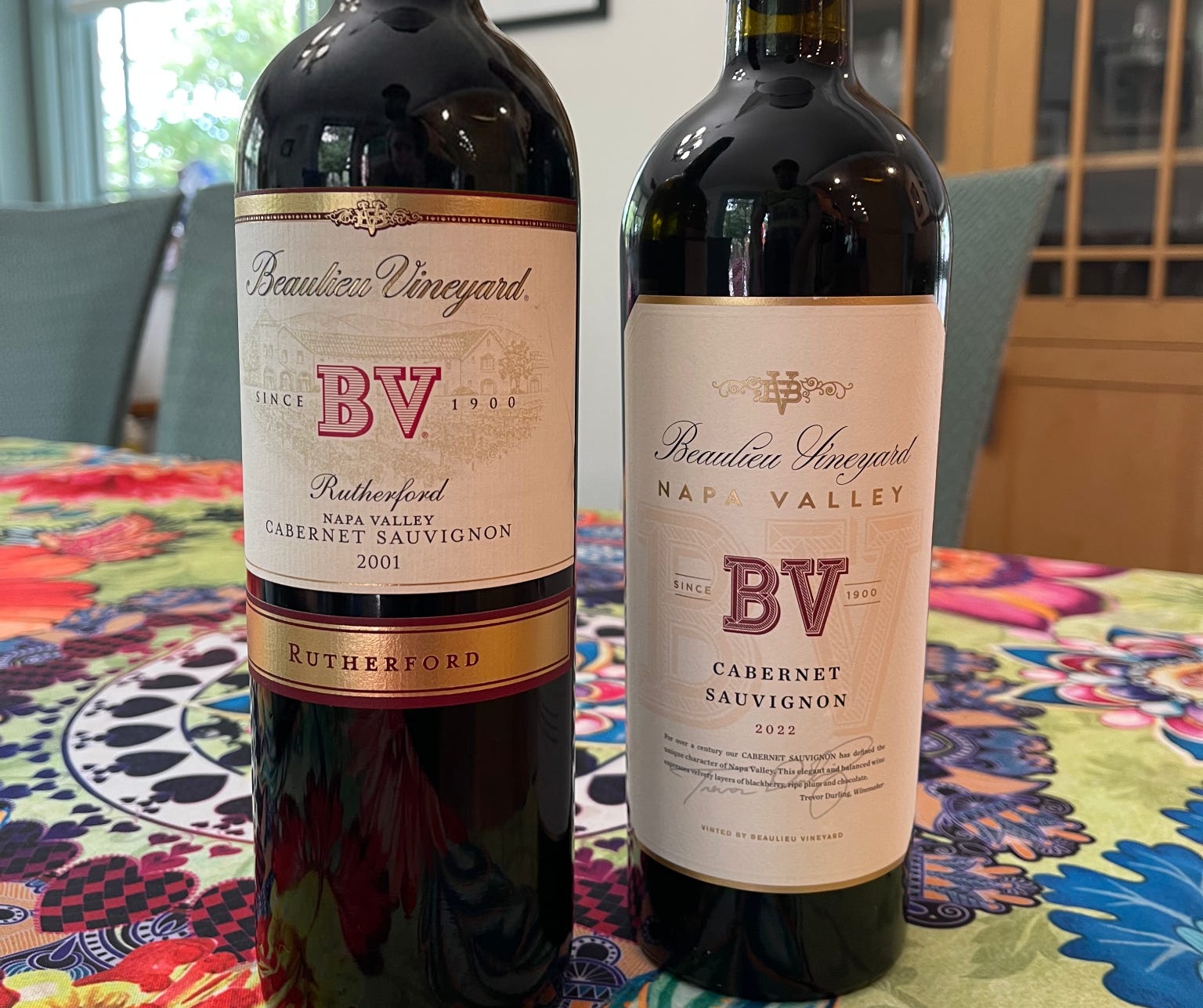
2022 BV Napa Cabernet Sauvignon / $30
Profile: Syrupy strawberry (like what you’d find on a cheap fruit cake), jammy black fruit, Mega Purple, warm plastic
Palate: Off dry, high acid, medium tannin, short finish, med+ body
The contents of this “formidable bottle” was indistinguishable from a run of the mill $10 California (region unspecified) red wine (grape unspecified) from your local CVS. BV has used a little marketing trick, relying only on the pedigree of the BV name and the word “Napa” on the label to imply price justification and quality – but Napa as a labeling term unfortunately means very little about quality these days beyond signaling that a “low price” is nearly guaranteed to represent a bad product.
This wine was hot on the alcohol and cold on everything else (LIKE ME!). Sports immediately detectable residual sugar – not something “we” typically look for in a “dry” red wine. It’s clearly manipulated, possibly infused with a healthy dose of Mega Purple (or some sweetening varietal concentrate that allows them to incorporate it into their stated varietal percentage breakdown from the online tech sheet) and whatever else they felt like jamming into the “bad time” we paid for #BadTimeMaxxing.
In the traditional sense, this is a terrible entry to the “Napa Cab” space, and really a bummer considering our comparison to the 2001 BV Rutherford Napa Cab which was absolutely exceptional. Of course, it’s not a 1 to 1, since you can still get Rutherford Cab from BV (closer to the $80 price point) but we selected what was readily accessible on store shelves and still sports the AVA distinction. At $30 a bottle, this couldn’t be an easier choice to pass up next time “we” are at the proverbial “Zeus Juice” market.
And though we often directionally agree with our good friend generous James, he came through with some absolutely unhinged scoring on this one (92 points JS), but we would bet our finest pair of drinking jorts that he wouldn’t come within 10 points of that score if he tasted it blind.
This one gets a solid American “F” on its proverbial “report card.”
No structure, all goop. One day closer to the end.
Score Breakdown: Balance 28 / Aroma & Flavor 12 / Intensity 15 / Complexity 4 / Length 4 = 63 Points (TP)
2001 BV Rutherford Napa Valley Cabernet Sauvignon / $85
Profile: Blackcurrant, black cherry, cedar, bay leaf, floral (rose, violet, lavender), tobacco, ballpoint pen ink, petrichor (wet earth & stone), chocolate, rum raisin, driftwood (the stiff kind!)
Palate: Dry, medium+ tannin, medium+ acid, medium+ body, long finish
MEANWHILE, in 2001… our pal BV made something that will change the course of your proverbial “life.”
This wine was absolutely stunning. Drinking at its peak at the “current moment,” it reminded us quite a lot of the 1993 Chateau Margaux “we” tasted a few years ago when we were “studying” diligently for our WSET L3, though this was even more concentrated and unquestionably more squarely in its prime.
A beautiful bouquet of floral notes (rose, violet, lavender) complimented by rich black fruits, classic aged and oaked cab notes of cedar, bay leaf, tobacco, petrichor and chocolate. Also sported some neat “bonus notes” of rum raisin and “driftwood” (IYKYK).
As we mentioned before, BV still makes a Rutherford Cab (albeit for about triple the price of the Napa Cab), and this has certainly stoked the curiosity in us to try a recent vintage of that. We will report back whence we do.
Funnily enough, while the 2022 scored 92 JS, this 2001 bottle scored a critic average on Wine Searcher of 83 points which is just as unhinged as the JS score for the 2022, especially when comparing the two bottles. Worth noting that most of those reviews were done within a few years of release, but since that applies to the JS score as well, I think we can reasonably assert that something doesn’t add up.
Score Breakdown: Balance 38 / Aroma & Flavor 19 / Intensity 15 / Complexity 10 / Length 15 = 97 Points (TP)
“IN CONCLUSION” – with Napa cab, you don’t typically get what you pay for – “you get what you get and you don’t get upset”™
By our accounting, the problem is less prevalent in Sonoma (though similar forces still drive prices up), and there are unquestionably some exceptions to the trend, even in Napa (Burgess Cab comes to mind).
That said, if disappointing wine in the $50 and under range doesn’t sound like your cup of tea, our advice is steer clear of “Napa” on the label.
But that’s just, like, our opinion, man. What do you think?
Let us know in the comments.
And as always, feel free to keep sending us your meanest death threats in the mail – we drink the stuff.
Until next time, HAPPY DRINKING PEOPLE.
Cheers,
Isaac & Zach
I actually worked at Beaulieu the harvest of 1999, and became familiar with the standards of excellence that were in place.
Your discussiona are of two wines, 11 years apart, made under different corporate ownerships.
The current corporate owner, your 2022 BV Cab producer, controls vast amounts of vineyards, several winery sites, huge tank storage, high speed bottling lines, all giving them the ability to shuffle wine around to plug into a dozen or more " wine programs" featuring different labels. All recognizable branding, yet no longer unique.
I worked for this corporate entity for 8 years, and was stunned when I first read the blend list ("the recipe") of a 250,000 gallon tank of wine destined to be bottled far from where it was made.
Anyway, the two wines you have discussed were made differently. A different spirit, different equipment, different methods, different target markets. The label design has some parallels, same BV logo, similar print fonts. But that's about it. Your taste buds know...
Some of the stuff coming out of the hilly bits on the Mayacamas range is ethereal. But land cost alone, as you point out, sets the starting price for any bottle coming out of the area so high that you really have to recalibrate expectations. Is the same money likely to get you better juice from somewhere else? Even nearby Sonoma which by no means is cheap? Absolutely.