


As “you all know” we recently propped your bloodshot little eyes open with toothpicks and exposed you (in public) to “the hard truth” about the annual Wine Spectator “Top 10” list.
If you’re among the <.000001% of people on earth who haven’t read it yet, go ahead and give it a goodly “once over” – but the short and sweet is that we found evidence of substantial biases and inherent flaws in “the system” that make that make it clear their idea of “the best” wines in the world is limited to a select few varieties/styles from a select few “blue chip” regions.
We had such a wonderful time flooding your “feeds” with neat little charts and graphs that we decided to “do it all over again” (HOORAY!) but this time focusing on a different “annual list” of “best wines” from another “big boy” in the proverbial “industry” – Wine Enthusiast.
Like last time, we dove head first into the shallow end of the last 10 years and picked apart the cute little “trends” in another little dataset.
If anyone wants to “noodle around” in that data themselves, we’re linking a spreadsheet here, which we mustered up the strength to break out into labeled columns for “your viewing pleasure.” If you don’t feel the need to do any “noodling,” fear not, moderate to severe noodling has already ensued on your behalf.
In general, our impression is that Wine Enthusiast does a better job of considering “the options” and there is more representation of varied styles and regions overall. That said, it’s far from perfect, so let’s dive into the juice…
“Best Wines” Selection Criteria
Unlike Wine Spectator, Wine Enthusiast doesn’t provide quite as clearly stated criteria for their selections. That said, here’s what they’ve stated in the preamble of the most recent list:
“Every year, our reviewers blind-taste 25,000 wines from around the world in search of those rare bottles that stop us in our tracks. The result is The Enthusiast 100 list—an annual showcase of wines that truly define the year for us. Think of it as an all-star roster of bottles that overdeliver, surprise, and remind us why we fell in love with wine.”
So it’s definitely more open-ended and subjective as “criteria” go, making it a little harder to critique whether they’ve honored a “stated process.” It doesn’t claim to be choosing from widely available wines or even specify how scoring or value plays into it, but I think it’s safe to say that the implication is that they’re calling these the best wines out there in 2025. After all, it’s literally called the “Best Wines of 2025” list.
So the question remains — do they give them all a fair shake?
The “Trends”
First of all, we hope you’ve been “saving your pennies,” because the most “groundbreaking” discovery from our little foray into the Enthusiast archives is that “The Top 10” (pulled from their annual best 100 wines of the year list) has recently shifted from “reasonably priced” to everything costing “a million gazillion dollars.” Back in the the days of yore (2016 to 2021 and prior), you could actually snag a bottle from the list for the price of a decent TOFU dinner – the median price hovered around a “relatable” $30 to $40.
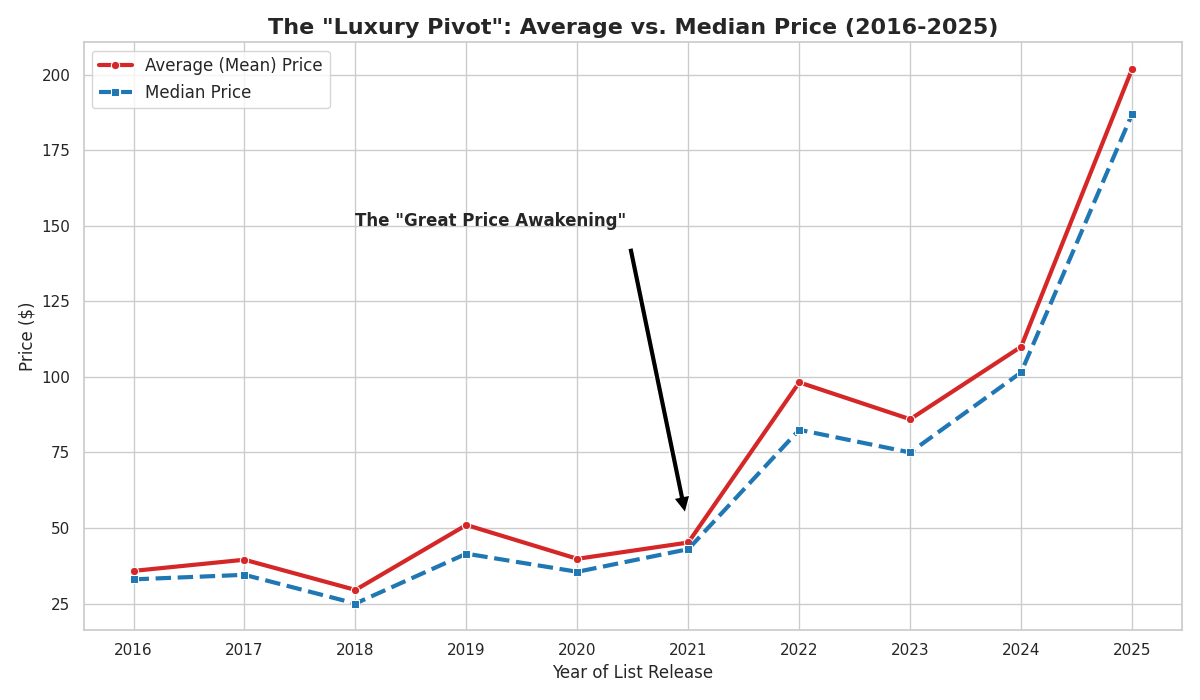
Fast forward to 2025, and the median has skyrocketed to an “eye-watering” $187 (you’re welcome for the toothpicks). It seems our enthusiastic friends have decided that “top quality” is now strictly reserved for reckless spenders (LIKE ME!) and rich people.
Speaking of “exclusivity,” if you aren’t making wine on ye olde “Left Coast” of the USA, you’re basically shouting into the void. The USA absolutely “demolished” the competition with 35 placements over the decade.
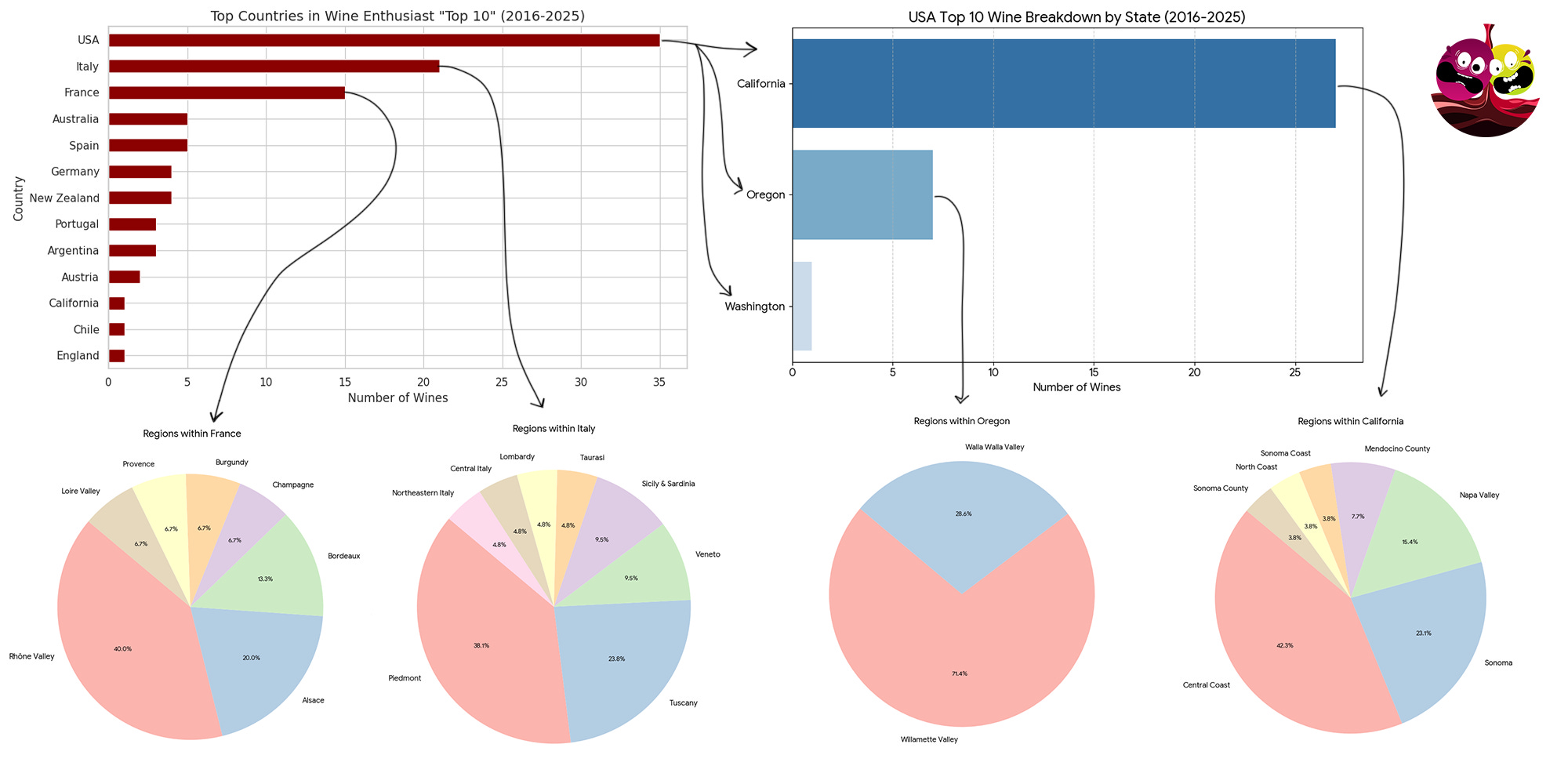
California, in particular, our “golden boy,” snagged 27 spots all by “his” lonesome – more than the next country, let alone state. If you’re a winemaker in, say, Virginia or New York, we have some “bad news” regarding your “relevance” in the eyes of the editors. Or is the wine just not good enough?
Like the Wine Spectator list, the “big three” (USA, France, Italy) clearly dominate here as well, but the overall diversity of countries that poke their heads out of the muck is significantly greater. 12 countries have placed (vs WS’s 8) and over 40 distinct regions are represented in total.
There is a clear preference among the tasters-that-be for very specific regions/sub-regions as well – but notably, these differ from those exhibited by Wine Spectator. We see that in California, Central Coast wines are by far the most dominant, followed by Sonoma and then Napa Valley (the favored region by WS). In Italy, Piedmont “leads the charge,” with Tuscany taking the passenger seat (Tuscany was the leader for WS by a substantial margin). Unlike Wine Spectator, which only featured a grand total of 4 regions within the country, Wine Enthusiast features 8. France all around is more balanced, with Rhône Valley (almost entirely Châteauneuf-du-Pape) taking the so-called “cake,” followed by Alsace (completely absent from WS), and then Bordeaux (WS leader).
As far as “varietals” go – Pinot Noir “wears the jorts” in the Wine Enthusiast household, showing a divergence from what we saw at WS where Cabernet Sauvignon, Bordeaux style blends and “other” red blends towered over our humble thin-skinned friend.
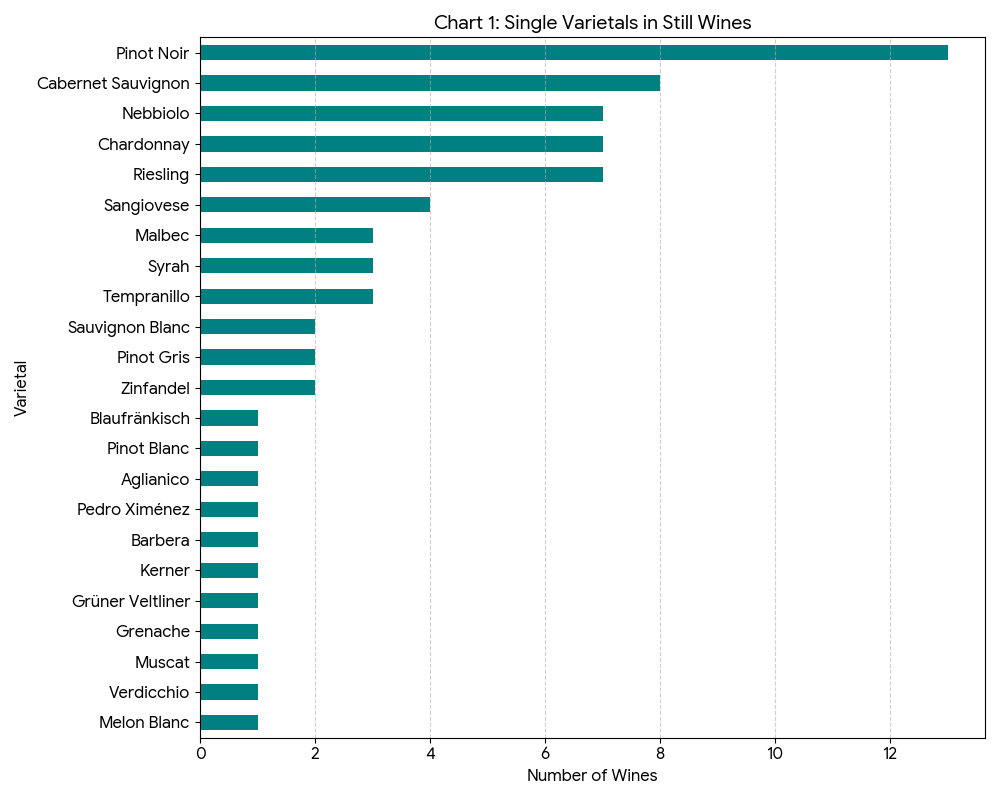
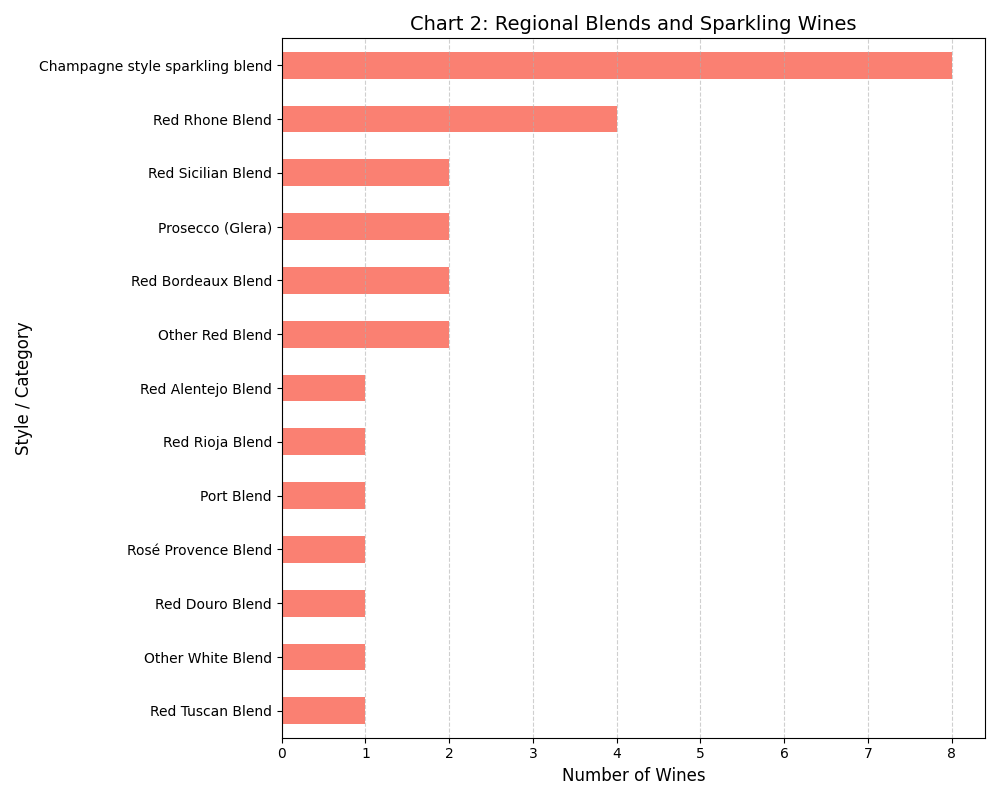
There’s 0 representation of Bordeaux’s right bank among Wine Enthusiast’s top 10 picks, and similarly, not one instance of single varietal Merlot. It may peer quietly out from under the covers in a few of the Cab-dominant blends, but otherwise there’s no F*****ING MERLOT.
Nonetheless, overall regional and varietal representation is much more robust on this list than the WS list.
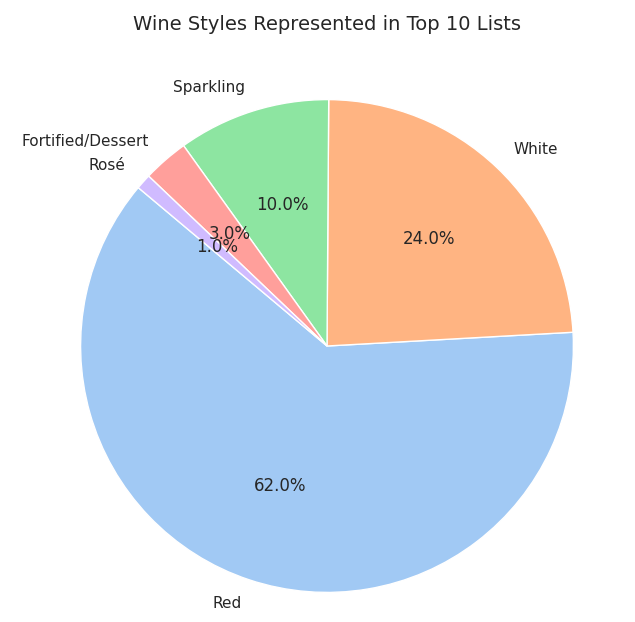
While red wines still make the biggest splash in the Wine Enthusiast list, there is far more representation of other “styles” than the Wine Spectator list. It shows 62% red vs WS 82%. Heck, they even threw in a rosé – bold choice we probably wouldn’t made, but here’s to them for “respecting the little guy.”
Interesting reaction - but what does it mean?
The overall takeaway here is that Wine Enthusiast’s “top picks” lean heavily into a mix of classic Old World regions and New World “benchmarks” while still showcasing a noticeable long tail of more “niche” regions and underappreciated “grapes.” By contrast, Wine Spectator’s top lists tend to be even more tightly focused on high‑volume, “market‑visible” categories (e.g., Bordeaux, Napa, Super Tuscans) with little appetite for “exploration” – so Enthusiast’s selection reads at a first grade level as slightly more open-minded, while Spectator’s appears more aligned with mainstream demand and ulterior motives.
What do you think – did we get it right? Wildly wrong? Did your own analysis and found something “neat”? Wine about it in the comments.
Until next time, HAPPY DRINKING PEOPLE.
Cheers!
Isaac & Zach
Gobsmacked by the 4-fold increase in average price of Enthusiast "top 100" wines in just 5 years.
Kudos for a lot of hard work going into this report, only to find what longtime readers have known all along: Yearly "Top" lists are always summaries of editorial boards' personal favorites. It's their magazine, they get to choose, and obviously it's from the pool of wines submitted or (the vast minority) "discovered" during the course of reviewers' travel/research. The good news insofar as Wine Enthusiast is that their personnel has slowly yet steadily changed over the years. Recent editors are more open minded, less conventional in their choices and outlooks., which has been reflected in their editorial over the past two, three years. Yes, they still fall for "prestige" brands and producers, and yes, it helps to advertise. Still, we're seeing more variety in their coverage, reflecting evolving consumer tastes.